A few thoughts on “What about Men?” by Caitlin Moran
Sophie Heine
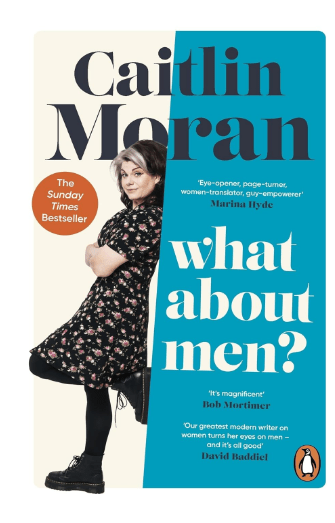
I was recently struck by a book I recently read: “What about Men?” by Caitlin Moran. This feminist writer has always had my admiration for her insightful analyses and her wit. I have read her views in magazines and in her books and have often agreed with a lot of them. However, this time, I could not disagree more about what she has written. In “What about men?”, there are of course very clever comments; Nonetheless, a lot of it is also very problematic: in this book, Caitlin Moran seems to think that men’s plight has been discarded for too long by society in general and by feminist thinkers in particular. Hardships such as an inability to express emotions , a higher rate of suicide or crime would mean that men need our help and our attention.
This really puzzles me. Whether I look at statistics or at the lives of real women around me, I certainly do not have the impression that the focus should now be about men. My take on the specific problems men as a group seem to have to address is also slightly harsher than the one taken by Moran. For instance, if men commit suicide more easily, including when they are fathers, is it really just because they cannot talk about their problems, have no space offering them that possibility and not enough friendships, as Moran offers, or is it also because they allow themselves to act more selfishly? Suicide is, even for a depressed person, one of the most selfish acts of all. Female depression is as higher as ever and yet women commit suicide much less than men do.
Certainly, they might have developed more friendships and believe in therapy a bit more; but also, they do not commit suicide because they would feel terribly bad to leave people behind, people who love them and need them. This might be the good side of the fact that women are encouraged to give a lot to others and care for them: it makes them feel responsible. Mothers, in particular, would almost never abandon their children. Whether this is purely constructed or partly natural (this is an endless debate and on that I would encourage you to read some of my books or articles on the subject), women do tend to behave with more emotional empathy than men. This does not mean that they are, deep down, less selfish. All human beings are partly selfish and partly altruistic. But it does mean that they chose to act in a more selfless way, particularly towards their relatives.
Of course, men live specific problems and those have to be addressed. The fact that much more men than women commit suicide, for instance, is a striking example of unaddressed issues that touch men more specifically; the fact that young men have more antisocial behaviours and that men in general commit more crimes is, indeed, a massive problem that has to be resolved. However, this book gives the impression that, after the battles found and won by women, it is now men’s turn to be defended, a bit as if the problems both sexes lived were equivalent.
Regarding the fact that crime is more widespread among men, including young men: again, my take on this would be a bit harsher. Violence is more accepted when it is carried out by men and even little boys are sill encouraged to fight much more than girls. Even if here was a more innate tendency for men to be aggressive or violent his does not mean that this should be accepted or tolerated. Women also have natural instincts which are always repressed (for ex. when a woman is called “hysterical” if she is hormonal before her periods); Men should be trained to control themselves much more. And as importantly, they should be incited to be more empathetic and realise the impact of heir acts on other people.
More generally, the stereotypes surrounding us still encourage or reward male selfish behaviours: at work and in society in general as much as in relationships, a man who focuses on his career and neglects his family is still not very badly perceived by society; if a woman does he same she will be negatively perceived, constantly.
Men as a group certainly have specific issues to tackle but a lot of the solutions to these problems mean dismantling the stereotypes that imprison individuals in very strict roles and replacing them with alternative visions which facilitate freedom (this necessitates mobilisation as much as intellectual work); Whereas women need to rediscover their natural selfishness, men need to learn to be more empathetic and more selfless.
see: Caitlin Moran, “What about Men?”, https://www.amazon.co.uk/What-About-Men-Caitlin-Moran/dp/1529149177/ref=asc_df_1529149177/?tag=googshopuk-21&linkCode=df0&hvadid=697325258123&hvpos=&hvnetw=g&hvrand=9899939270830817190&hvpone=&hvptwo=&hvqmt=&hvdev=c&hvdvcmdl=&hvlocint=&hvlocphy=9045888&hvtargid=pla-2197066158864&psc=1&mcid=072fbacd75913d359e4ca71579cc61ee&th=1&psc=1&gad_source=1
Sophie Heine, DIFFERENTES, LIBRES ET EGALES: Quelques pistes pour parler aux femmes aujourd’hui : https://www.amazon.co.uk/DIFFERENTES-LIBRES-EGALES-SOPHIE-HEINE/dp/287003928X/ref=sr_1_2?crid=1ROZ80JQ0NM9B&dib=eyJ2IjoiMSJ9.Vk0E_vIYNMLeO20nhi4-J0rLpAoHiLTgnjbXqaUL1o8.GAZDcFWz8oTcm4V9z9PaFQhBQC0ZGTyXuBAJiC_y4MY&dib_tag=se&keywords=sophie+heine+femmes&qid=1721127179&s=books&sprefix=sohie+heine+femmes%2Cstripbooks%2C119&sr=1-2
 Food for Thought - Sophie Heine